Begin with history, which is perhaps the greatest predictor of such things. Though it’s tempting to view India through the gloss of that famous epithet “World’s Biggest Democracy”, its sixty years of nationhood have been more notable for their tumult than stability: three wars with Pakistan, and the conflict over Kashmir still simmering; war with China; the assassinations of two prime ministers; two years of emergency rule; battles with Punjabi separatists; and throughout, periodic flarings of civil unrest. Given such a history, it’s remarkable that democracy should have endured at all—many post-colonial nations have collapsed into authoritarianism or calcified as one-party states beneath far less wrenching pressures. Despite thirty years of relative political stability, however, India remains a nation wracked by forces that try the mettle of its democracy: Naxalite (Maoist) rebels in the South and Northeast; wrangling with Pakistan over borders and territory and the concomitant threat of terrorism on Indian soil (although it should be noted that terrorism in India has many faces and many objects); agitation over political and other reservations by Scheduled Castes (SCs), Scheduled Tribes (STs), and Other Backward Classes (OBCs); and the omnipresent specter of “communalism”—euphemism in polite society—the press, political circles—for Hindu-Muslim violence.
With Pakistan absorbed in a struggle for the preservation of its historically (more or less) secular and democratic state, it is communalism that is perhaps the clearest present threat to Indian peace and prosperity (although some would argue, and not without merit, that in its instability Pakistan represents an even graver threat to India than it does when at peace). The danger of communal violence seems especially keen now that the Hindu nationalist BJP (Bharatiya Janata Party) is resurgent following important victories in state elections in December (including a volatile contest in the key state of Gujarat). Historically, BJP leaders have had little compunction about exploiting and even instigating Hindu-Muslim tensions for political gain. Indian politicians are, if anything, even more prone than their American counterparts to foist blame on their enemies for any national misfortune or disgrace—accusation and recrimination being a sort of double reflex in politics here—and the BJP is almost as fond of blaming Muslims and other non-Hindus for the country’s ills as it is the nationally ruling Congress Party. It’s no coincidence that the BJP played an incendiary role in India’s two most recent large-scale incidents of communal violence, each of which resulted in thousands of deaths, primarily of Muslims.
And yet, given the overwhelmingly Hindu character of the nation—82% of the populace, as opposed to only 13% Muslim—it seems unlikely that communalism itself poses an existential threat to India (unless, that is, it should manage to precipitate nuclear war on the subcontinent)—although not insignificant, the Muslim minority could not endure a protracted skirmish with Hindu nationalists. Though perhaps the most profound schism in Indian society, the Hindu-Muslim divide is not one so wide as to cause permanent rupture. In fact, no single divide in India is broad enough to threaten a lasting division of the nation; it is the aggregate fracturing of hundreds of minute divisions among its people that, given a single seismic event, one shaking the entire country, could cause the entire edifice of the state to crumble.
It is a terrible irony that some of the nation’s greatest strengths—its diversity, its commitment to political, educational, and economic inclusion of traditionally marginalized populations, and its strongly federal system of governance, among others—are also fundamental sources of division. In the U.S. we tend to think of diversity as an unalloyed good, a desideratum, something to be striven for as a just end in itself rather than as a means to some other goal, forgetting that diversity, however desirable and beneficial, is also very often a catalyst for conflict (which isn’t to say that it should ever be forsworn as a social goal or otherwise). India is a state comprised of thousands of ethnic groups, castes, sub-castes, jatis, and other distinct populations. It is the birthplace of three major world religions (Hinduism, Buddhism, and Sikhism), and with the exception of Indonesia and Pakistan, it is home to more Muslims than any other nation on the planet. The last census found that more than 1,600 languages are spoken within its borders. Indians joke that India is not a single large country, but thousands of tiny ones: travel only fifty kilometers from wherever you are, they say, and you will encounter a new language, a new culture. This is said with pride and a bit of astonishment; even Indians can’t believe how disparate the nation’s population is.
This grand diversity, so different from our conception of the term, one which defines diversity most readily in racial and national terms—diversity is the New York melting pot—isn’t inherently dangerous, especially so long as all of its constituents share some common identity or sustaining narrative of unity. This isn’t necessarily true of India, where, despite a visible patriotism among its people, significant segments of the population tend not to identify with their country of birth and residence (one old man in a village I visited in September didn’t even understand that he was a citizen of a broader political entity called India). The nation’s extensive system of political, educational, and employment reservations for SCs, STs, and OBCs—an impressive and commendable program of affirmative action—has often exacerbated this disassociation from nation in favor of narrower allegiances to caste or tribe.
The reservation system, conceived of to speed the integration of all segments of the population—specifically those historically repressed—into broader Indian society and to redress past injustice, has, in some cases, resulted in the hardening of traditional distinctions. Ethnic identity often becomes more important than national identity, because it affords advancement; resentment builds among the non-SC, ST, or OBC population, particularly its impoverished elements; unrecognized marginalized groups agitate, often violently, for legal recognition of SC, ST, or OBC status; and recognized SC, ST, and OBC groups stridently oppose the efforts of these groups because their recognition will result in a reduction in the reservations of the already recognized groups. In Rajasthan, the Gujjar people currently seek ST status and are employing large-scale demonstrations and blocking roads in pursuit of that end; their fiercest opponent hasn’t been the police but the Meenas, one of Rajasthan’s ST groups.
Given India’s history, diversity, and vastness, both of area and population, the nation’s federalism is both strategic and concessionary—it seems the best way to govern an enormous, far-flung, and multifarious population as well as a necessary acknowledgement of the country’s heritage of fragmentary administration—even the British failed to bring the nation under a single, central government. India is nearly as much colonial fabrication as any African state, and perhaps the only thing in which Indians have ever been united was their detestation of colonial rule; thus the reliance on a system of governance in which Indians states have been given an autonomy of which the American Federalist Society would heartily approve. Yet federalism has also perpetuated the historical geographic and cultural divisions of the subcontinent and highlighted the inequalities between populations—the development of southern states such as Kerala and Tamil Nadu is several generations advanced beyond that of others like Bihar, Orissa, and Assam, where the quality of life of inhabitants is more typical of sub-Saharan Africa and the world’s least developed countries than what one would expect of an emerging economic power like India.
In the minds of Indians, state lines are too often more than imaginary boundaries; they are tangible demarcations of different peoples. In a nation where everyone is an “other” to everyone else, state affiliation is just another way of defining the “otherhood” of another person. And the fracturing of state identity is not yet complete: three new states were born in 2000 out of old ones—Uttaranchal from Uttar Pradesh, Jharkand from Bihar, and Chhattisgarh from Madhya Pradesh—and it seems likely that another state, to be called Bundelkhand, will emerge from Madhya Pradesh and Uttar Pradesh by the end of the decade. Tribal regions in several other states, following the lead of Jharkand and Chhattisgarh, are also working toward independence. The further atomization of the Indian state, with all of its ramifying social implications, seems inevitable.
On January 27, Raj Thackeray, the leader of the Maharashtra Navnirman Shena (a Hindu nationalist party and affiliate of the BJP), publicly denounced the presence of North Indians in Mumbai, specifically citing emigrants from the states of Bihar and Uttar Pradesh (incidentally two of the poorest states in the country), claiming that they were taking South Indian jobs and insulting South Indian culture with their adherence to native practices. Mumbai is India’s most cosmopolitan city; Thackeray’s outburst was roughly equivalent to Al Sharpton telling all of the Mississippians and Alabamans in New York City to get the hell out. Thackeray’s xenophobia (if it can even be called that) seems absurd, and yet it inspired a wave of violence that left at least one man dead; on Saturday Thackeray warned against public celebrations of Uttar Pradesh Day in Maharashstra, suggesting that Shiv Sena members would put down by force all who disobeyed his extralegal proscription. The hullabaloo surrounding Thackeray is a morbid outgrowth of an endemic prejudice: in private conversation I have been told by educated South Indians that North Indians are generally unfriendly, arrogant, and disdainful toward those who don’t speak Hindi, and many North Indians' opinions of Southerners are equally derogatory.
Hindu vs. Muslim (and other non-Hindus), caste vs. caste, tribe vs. tribe, state vs. state, tribal vs. non-tribal, North vs. South: all are divisions daily in evidence in India’s newspapers. The largely invisible divisions and resentments of class, education, and rural vs. urban populations are no less profound for their latency. In a nation of a billion ruptures--some tiny cracks, others daunting crevasses, but none so large as to alone be capable of collapsing the idea of the Indian state--what sort of force is then capable of convulsing the entire nation at once, thereby acting on multiple ruptures concurrently?
Tuesday, February 19, 2008


Sunday, February 10, 2008
Reduction, First Attempt: Like V.S.
I have quixotically hoped, during my time in India, to arrive at some confident assaying of the Indian character—the spirit of the nation, the psyche of its people, that sort of thing—knowing full well that it was, by its very nature, an impossible undertaking, and probably an undesirable one as well. I have wanted, in some sense, to do as V.S. Naipaul has so often done—to enfold an entire country, a people, in a single well-crafted sentence, to encapsulate them in a terse declaration, to reduce them to a single idea. Naipaul really has reduced entire peoples—that is the proper word—for he rarely has had much but scorn for the inhabitants of what people used to call the Third World. He has found them ignorant and superstitious and wanting for industry and originality; after having traveled much of the post-colonial world in the last half century, his assessment of the progress of its inhabitants is starkly uncharitable. They have grown and achieved little, he feels, since the lifting of the colonial yoke—the implication being that if a people clamor for independence, they should not then squander its dispensation.
It is likely that Naipaul has only escaped lasting opprobrium because, as a native of Trinidad, he was once one of the liberated peoples that he savages; just as only a black person can utter “nigger” and not be castigated, so can only a post-colonial describe his own country as a “picaroon society with its taste for corruption and violence and its lack of respect for the person” without serious censure (it also doesn’t hurt that his writing bursts with a rare intelligence and percipience). That’s not to say that Naipaul doesn’t acknowledge and tacitly condemn the deleterious colonial legacy, in particular its psychological effects; his position on the issue is not an extreme one, and yet his thinking does represent one particular polar strain—that the problems of the post-colonial world can largely be imputed to its people and culture—in the interpretation of its history. But in examining his work, one must accept, with the requisite grain of salt, Naipaul’s fundamental conservatism, his arrogance, his chauvinism, and the fact that these tendencies have only deepened with age (he has even gone so far as to recently deprecate the work of his erstwhile friend and fellow Caribbean native and Nobel laureate Derek Walcott).
An opposing strain of interpretation suggests that colonialism arrested and blighted the efflorescence of established and well-ordered societies the world over, where people lived largely peaceful and mutually reinforcing existences free from the taint of the unfettered pursuit of profit, the impulse to exploit the natural world, and the desire to master one’s fellow man. This romanticization possesses more than the whiff of the Noble Savage myth in it, and notwithstanding the slivers to be found in each of these strains of interpretation, it should be evident that the whole truth, as it invariably does, lies somewhere in between the two.
Naipaul has been especially critical of his ancestral homeland, and perhaps no nation has so embodied the frustrated promise of the pre- and post-colonial periods as has India. India’s value as a trading hub to the Portuguese, British, and French was enormous—it may very well have been the most precious jewel in the diadem of Empire—and few if any post-colonial nations have contributed more (both through its native population and its diaspora), in real terms, to the world economically and culturally since independence. Everyone is by now familiar with the presumptive narrative of Indian ascent: the still fecund IT industry, the febrile financial sector, the burgeoning professional class, the prodigious entertainment biz, the enlightened government (“the world’s biggest democracy”!)—we have entered the Asian century, even if it’s not yet evident.
And yet: the agricultural sector’s share of the economy is shrinking, even as it employs the majority (56%) of the Indian workforce. The epidemic of farmer suicides seems intractable, as does the scourge of female feticide. Primary school enrollment is abysmally low and the child mortality rate disturbingly high, particularly for a nation aspiring toward a position of global prominence--India was ranked only 128th out of 177 countries in the UN's most recent Human Development Report. The entire country has a mere 5,000 miles of four-lane highway; in comparison, China has constructed more than 15,000 miles of 4-6 lane access-controlled expressways in the last ten years alone. And while a staggering number of Chinese, 180 million, live on the equivalent of less than US$1 per day (the World Bank measure of extreme poverty), 370 million Indians contend with such destitution. That’s almost one-quarter again the entire population of the U.S. and considerably more than the 300 million living in extreme poverty in sub-Saharan Africa—and people speak of this impoverished mass as the “other” India, as if it represented some aberrancy.
Sir Vidia, the Grand Belittler, would undoubtedly seize upon the recalcitrant residue of brutality clinging to Indian culture as evidence of its prevailing backwardness: the feticide of course, but also the preponderance of lynchings, the acid attacks of spurned suitors, the culture of scholastic bullying (known as “ragging”; it seems to inspire at least one prominent murder case each month), the temple stampedes, the so-called “communal” violence (to which we shall return). Such appeals are a double-edged sword, however, as most cultures harbor an atavistic bloodlust, even Naipaul’s beloved British; an accounting of the signifiers of contemporary American brutality would likely consume the better part of an entire post.
What is most distressing about India, then, is not its brutality, which is quite commonplace even among so-called “advanced” societies, or its dismal social indicators, or even the boggling number of poor; it is the very real fracturing of its populace along hundreds, if not thousands of fault lines, both visible and invisible—cracks delineating religion, caste, class, wealth, politics, geography, culture, and language, among other things—which, when coupled with a tendency toward brutality among certain segments of its population, is the greatest cause for alarm. Though perhaps I am alone in suggesting such a possibility, it seems that India possesses more than the necessary ingredients for fierce and protracted civil strife—though one not imminent or even near enough to be easily discernible, it might arrive twenty or thirty years in the future, when the forces of cleavage have had time to widen small fissures into unbridgeable chasms of discontent and alienation.
It is likely that Naipaul has only escaped lasting opprobrium because, as a native of Trinidad, he was once one of the liberated peoples that he savages; just as only a black person can utter “nigger” and not be castigated, so can only a post-colonial describe his own country as a “picaroon society with its taste for corruption and violence and its lack of respect for the person” without serious censure (it also doesn’t hurt that his writing bursts with a rare intelligence and percipience). That’s not to say that Naipaul doesn’t acknowledge and tacitly condemn the deleterious colonial legacy, in particular its psychological effects; his position on the issue is not an extreme one, and yet his thinking does represent one particular polar strain—that the problems of the post-colonial world can largely be imputed to its people and culture—in the interpretation of its history. But in examining his work, one must accept, with the requisite grain of salt, Naipaul’s fundamental conservatism, his arrogance, his chauvinism, and the fact that these tendencies have only deepened with age (he has even gone so far as to recently deprecate the work of his erstwhile friend and fellow Caribbean native and Nobel laureate Derek Walcott).
An opposing strain of interpretation suggests that colonialism arrested and blighted the efflorescence of established and well-ordered societies the world over, where people lived largely peaceful and mutually reinforcing existences free from the taint of the unfettered pursuit of profit, the impulse to exploit the natural world, and the desire to master one’s fellow man. This romanticization possesses more than the whiff of the Noble Savage myth in it, and notwithstanding the slivers to be found in each of these strains of interpretation, it should be evident that the whole truth, as it invariably does, lies somewhere in between the two.
Naipaul has been especially critical of his ancestral homeland, and perhaps no nation has so embodied the frustrated promise of the pre- and post-colonial periods as has India. India’s value as a trading hub to the Portuguese, British, and French was enormous—it may very well have been the most precious jewel in the diadem of Empire—and few if any post-colonial nations have contributed more (both through its native population and its diaspora), in real terms, to the world economically and culturally since independence. Everyone is by now familiar with the presumptive narrative of Indian ascent: the still fecund IT industry, the febrile financial sector, the burgeoning professional class, the prodigious entertainment biz, the enlightened government (“the world’s biggest democracy”!)—we have entered the Asian century, even if it’s not yet evident.
And yet: the agricultural sector’s share of the economy is shrinking, even as it employs the majority (56%) of the Indian workforce. The epidemic of farmer suicides seems intractable, as does the scourge of female feticide. Primary school enrollment is abysmally low and the child mortality rate disturbingly high, particularly for a nation aspiring toward a position of global prominence--India was ranked only 128th out of 177 countries in the UN's most recent Human Development Report. The entire country has a mere 5,000 miles of four-lane highway; in comparison, China has constructed more than 15,000 miles of 4-6 lane access-controlled expressways in the last ten years alone. And while a staggering number of Chinese, 180 million, live on the equivalent of less than US$1 per day (the World Bank measure of extreme poverty), 370 million Indians contend with such destitution. That’s almost one-quarter again the entire population of the U.S. and considerably more than the 300 million living in extreme poverty in sub-Saharan Africa—and people speak of this impoverished mass as the “other” India, as if it represented some aberrancy.
Sir Vidia, the Grand Belittler, would undoubtedly seize upon the recalcitrant residue of brutality clinging to Indian culture as evidence of its prevailing backwardness: the feticide of course, but also the preponderance of lynchings, the acid attacks of spurned suitors, the culture of scholastic bullying (known as “ragging”; it seems to inspire at least one prominent murder case each month), the temple stampedes, the so-called “communal” violence (to which we shall return). Such appeals are a double-edged sword, however, as most cultures harbor an atavistic bloodlust, even Naipaul’s beloved British; an accounting of the signifiers of contemporary American brutality would likely consume the better part of an entire post.
What is most distressing about India, then, is not its brutality, which is quite commonplace even among so-called “advanced” societies, or its dismal social indicators, or even the boggling number of poor; it is the very real fracturing of its populace along hundreds, if not thousands of fault lines, both visible and invisible—cracks delineating religion, caste, class, wealth, politics, geography, culture, and language, among other things—which, when coupled with a tendency toward brutality among certain segments of its population, is the greatest cause for alarm. Though perhaps I am alone in suggesting such a possibility, it seems that India possesses more than the necessary ingredients for fierce and protracted civil strife—though one not imminent or even near enough to be easily discernible, it might arrive twenty or thirty years in the future, when the forces of cleavage have had time to widen small fissures into unbridgeable chasms of discontent and alienation.
Saturday, January 26, 2008
Touring as Something Other than Hell, Part 2: Himalayan Vistas, River Worship, and a Thrilling Roar
Following the trauma of Delhi and Agra, the hills and fields and rivers of Uttaranchal, a state carved from Uttar Pradesh in 2000, seemed a proper antidote to the sclerotic and suffocating city. With our base in the comparatively drowsy and diminutive capital of Dehra Dun (which we explored on our first day in the state), my mom, dad, brother, and I made day trips to Mussoorie and Haridwar, before departing for our final stop outside of Ramnagar and Corbett Tiger Reserve.

Mussoorie: Located approximately two kilometers above sea level (6561 feet), Mussoorie, the “Queen of Hill Stations,” is a flock of buildings—including an inordinate number of hotels—flung across a heavily wooded ridge in the Himalayan foothills. The only road to Mussoorie from Dehra Dun (Elev: 2296 feet) is tortuous and steep, and though only about 30 kilometers separate the cities, it takes well over an hour to traverse the distance between the two. Although it aspires to offer a great deal to tourists, Mussoorie is little more than a grand view—two views, in fact, each dramatic in its own fashion. To the south, in the direction of Dehra Dun, a panorama of the Doon Valley unfolds, green and riven by the fingers of the foothills, which point towards Delhi. To the north, peeking just above a muscular ridge, are the distant snow-packed heads of the Himalaya. Too bad, then, that the day was swimming in haze; the southern exposure in particular was blurred and indistinct. It hardly mattered, though: the city had postcard poise (see above) and even from afar the Himalaya announced themselves with a fluent grandiosity.
Haridwar: Wiith my dad was sidelined by intestinal distress, the next day my mom, brother, and I departed for Haridwar alone—alone, that is, save for our driver Samuel and his four-year-old munchkin son, Lucky. As a result of its propinquity to the source of the Ganges River (Ganga in Hindi), Haridwar is one of the four holiest cities in all of Hindu; it’s also believed that Lord Vishnu spilled nectar here and in doing so left his footprint behind. The city stretches for several kilometers along the river and occupies a narrow swath of land between the Ganga and a steep, scrubby ridge. No doubt owing to the nearness of its source, the Ganga was a pale and milky green (shades of the non-St. Paddy's Day Chicago River) and looked nearly clean enough to drink from.

Haridwar has two famous hill-top temples, Mansa Devi and Chandi Devi, both most enjoyably accessed by cable car—or ropeline, as it’s known in India; in fact, the ropeline to Chandi Devi is the second longest in the country. The views from the temples, Chandi Devi in particular, were commanding, or rather would have been if not for the unshakable haze. The temples themselves are uninspiring—dispiriting is a better word, given that their primary function seems to be the extraction of rupees from visitors’ pocketbooks (a subject which certainly merits its own post, although it’s likely I’ll never get around to writing it)—and the temple monkeys (above with pilfered ice cream cone) are even better shake-down artists than the pandits. In accordance with the American way, the Gaffs tried to take more than they gave, and we made out handsomely: tikkas for our foreheads, bracelets for our wrists, consecrated money for our wallets, consecrated sweets for our bellies, and marigold garlands for all! My mom’s garland was the heaviest and gaudiest, hanging below her waist, while my brother’s was small and understated. Mine was just right.
After looting Mansa Devi, we secured a spot along the Ganga at the Har-Ki-Pairi (The Footstep of God) ghat, where the daily Ganga aarti ceremony is held, and spent the ninety minutes before sunset watching inspired bathers and waders shiver in the current and monkeys scramble across roofs, trees, and walls on the opposite bank. As there is not a single square inch of India where the pursuit of money is thought profane and properly barred, we were also forced to fend off a steady and miscellaneous stream of vendors, beggars, and children demanding ten rupees for a tikka. One fellow with broken eyeglass lenses and ragged clothes importuned me to convey his plaints to the President of the United States and the U.N.—the tribals and lower castes of Uttaranchal were being brutally suppressed, he told me. He spoke fluent, stilted English and didn’t ask for money.

At dusk the Ganga aarti began. I don’t know much of the ceremony’s history or the significance of its forms and rituals; it is simple veneration of the river—the Great Mother—and aarti is a particular variety of worship involving the lighting of lamps. At 5:45, bells began to clang in that joyful, rhythmless temple style and five men came to the river’s edge bearing large lamps. As ponderous music piped over loudspeakers, the lamps were ignited and held aloft. Some of the assembled (and there were likely a few thousand) sang along to the music in call-and-response style; the calling was done by a shrill and nasal soprano voice whose style typified what, until relatively recently, was considered the truest, most beautiful expression of the female singing voice in India (it used to grate on me terribly; now it’s as much a part of the unregistered ambient tapestry of this country as the honking of car horns). At indecipherable intervals, the men slowly and gently swooped the lamps in an arc below their knees. The lamps burned with some high-octane fuel—their shivering flames rose several feet into the gloom (see above), projecting solid stripes of orange light onto the river’s surface. Darkness settled, and glowing offerings—sturdy vessels constructed of large tree leaves and brimming with the blossoms and petals of flowers arrayed around a central candle—were released into the current. I had hoped that the entire river might be choked and glittering with their light; alas, the scintillating armada of my imagination was, in reality, no more than a twinkling flotilla.
Corbett Tiger Reserve: It all comes back to tigers. For the trip’s grand finale, we entered the forests of the night in search of that singular, ferocious, and most fearsome of predators in a nation overflowing with hot-blooded hunters (not the least of which are the omnipresent vendors, hawkers, and beggars--it all comes back to them too). We arrived at the entrance of the Reserve shortly after 6, the first jeep of many to roll up in the pre-dawn gloom, waiting for the gates to admit us at 6:30. It would be nearly 5 when we departed, dusty, dead-eyed, and deprived of a tiger sighting—that is not to say, however, that we left disappointed.
Corbett National Park is enormous, more than 1300 square kilometers, and its Tiger Reserve, though smaller (around 500 square km), is nonetheless significant. And while only 15% of the total area of Ranthambore Park is accessible to tourists, it would seem that nearly all of Corbett can be reached by jeep—in the afternoon we spent hours traversing muddy tracks deep in the forest, combing the remote bowels of the Reserve for the striped menace of legend. Corbett is even more beautiful than Ranthambore, greener and more thickly forested, full of rills and broad, stony riverbeds, deep ravines, bluffs, gently sloping hills, and stands of tall, yellowing grass perfect for concealing tigers. It abounds in deer (three species) and monkeys (two species), and we also observed a wild boar, several varieties of birds, and a sizable herd of pillaging elephants.

On our second venture past the elephants, in the course of making our way back to the Reserve’s “campus” for lunch, we stopped so that our guide, who moonlighted as a wildlife photographer and seemed dismayed by our frugal snapping, could amuse himself with my camera. After several minutes of shooting, one of the elephants took exception to our presence and made an abortive charge toward our jeep, stopping perhaps thirty yards short and releasing a minatory trumpet. We were suitably shaken and urged our driver to get moving; however, shortly thereafter, a guttural bark somewhere in the forest off to our left caused him to throw the jeep into reverse and rapidly retrace our tracks. The bark, we quickly learned, was the distress call of the langur monkey; it suggested that a tiger was in the vicinity.
We waited attentively for perhaps ten minutes while the barks continued intermittently, occasionally drifting back in the direction of the elephants (who continued their pillaging unperturbed in the distance), occasionally backtracking further in the opposite direction. It had been several minutes since the last bark when two elephants behind us suddenly made a right turn toward the road; we heard a brief bellow from close by. “Tiger roar!” our guide whispered excitedly (it wasn’t a proper roar—tigers are capable of dozens of vocalizations), but instead of backing up in the direction of the sound, we remained rooted in place and waited, every fiber of our being focused on the forest behind us. And waited.
We never saw the tiger; it never emerged from the thick undergrowth, at least within eyeshot. Nevertheless, the experience was thrilling—in many ways more thrilling than spotting the Lady of the Lake in Ranthambore. It was the thrill of pursuit and the thrill of fear that quickened the pulse—the fear that the thing you were pursuing, a beast so terrible it turned aside creatures more than ten times its own size, might decide, on a whim, to turn on you. And the thrill didn’t soon subside.

Mussoorie: Located approximately two kilometers above sea level (6561 feet), Mussoorie, the “Queen of Hill Stations,” is a flock of buildings—including an inordinate number of hotels—flung across a heavily wooded ridge in the Himalayan foothills. The only road to Mussoorie from Dehra Dun (Elev: 2296 feet) is tortuous and steep, and though only about 30 kilometers separate the cities, it takes well over an hour to traverse the distance between the two. Although it aspires to offer a great deal to tourists, Mussoorie is little more than a grand view—two views, in fact, each dramatic in its own fashion. To the south, in the direction of Dehra Dun, a panorama of the Doon Valley unfolds, green and riven by the fingers of the foothills, which point towards Delhi. To the north, peeking just above a muscular ridge, are the distant snow-packed heads of the Himalaya. Too bad, then, that the day was swimming in haze; the southern exposure in particular was blurred and indistinct. It hardly mattered, though: the city had postcard poise (see above) and even from afar the Himalaya announced themselves with a fluent grandiosity.
Haridwar: Wiith my dad was sidelined by intestinal distress, the next day my mom, brother, and I departed for Haridwar alone—alone, that is, save for our driver Samuel and his four-year-old munchkin son, Lucky. As a result of its propinquity to the source of the Ganges River (Ganga in Hindi), Haridwar is one of the four holiest cities in all of Hindu; it’s also believed that Lord Vishnu spilled nectar here and in doing so left his footprint behind. The city stretches for several kilometers along the river and occupies a narrow swath of land between the Ganga and a steep, scrubby ridge. No doubt owing to the nearness of its source, the Ganga was a pale and milky green (shades of the non-St. Paddy's Day Chicago River) and looked nearly clean enough to drink from.

Haridwar has two famous hill-top temples, Mansa Devi and Chandi Devi, both most enjoyably accessed by cable car—or ropeline, as it’s known in India; in fact, the ropeline to Chandi Devi is the second longest in the country. The views from the temples, Chandi Devi in particular, were commanding, or rather would have been if not for the unshakable haze. The temples themselves are uninspiring—dispiriting is a better word, given that their primary function seems to be the extraction of rupees from visitors’ pocketbooks (a subject which certainly merits its own post, although it’s likely I’ll never get around to writing it)—and the temple monkeys (above with pilfered ice cream cone) are even better shake-down artists than the pandits. In accordance with the American way, the Gaffs tried to take more than they gave, and we made out handsomely: tikkas for our foreheads, bracelets for our wrists, consecrated money for our wallets, consecrated sweets for our bellies, and marigold garlands for all! My mom’s garland was the heaviest and gaudiest, hanging below her waist, while my brother’s was small and understated. Mine was just right.
After looting Mansa Devi, we secured a spot along the Ganga at the Har-Ki-Pairi (The Footstep of God) ghat, where the daily Ganga aarti ceremony is held, and spent the ninety minutes before sunset watching inspired bathers and waders shiver in the current and monkeys scramble across roofs, trees, and walls on the opposite bank. As there is not a single square inch of India where the pursuit of money is thought profane and properly barred, we were also forced to fend off a steady and miscellaneous stream of vendors, beggars, and children demanding ten rupees for a tikka. One fellow with broken eyeglass lenses and ragged clothes importuned me to convey his plaints to the President of the United States and the U.N.—the tribals and lower castes of Uttaranchal were being brutally suppressed, he told me. He spoke fluent, stilted English and didn’t ask for money.

At dusk the Ganga aarti began. I don’t know much of the ceremony’s history or the significance of its forms and rituals; it is simple veneration of the river—the Great Mother—and aarti is a particular variety of worship involving the lighting of lamps. At 5:45, bells began to clang in that joyful, rhythmless temple style and five men came to the river’s edge bearing large lamps. As ponderous music piped over loudspeakers, the lamps were ignited and held aloft. Some of the assembled (and there were likely a few thousand) sang along to the music in call-and-response style; the calling was done by a shrill and nasal soprano voice whose style typified what, until relatively recently, was considered the truest, most beautiful expression of the female singing voice in India (it used to grate on me terribly; now it’s as much a part of the unregistered ambient tapestry of this country as the honking of car horns). At indecipherable intervals, the men slowly and gently swooped the lamps in an arc below their knees. The lamps burned with some high-octane fuel—their shivering flames rose several feet into the gloom (see above), projecting solid stripes of orange light onto the river’s surface. Darkness settled, and glowing offerings—sturdy vessels constructed of large tree leaves and brimming with the blossoms and petals of flowers arrayed around a central candle—were released into the current. I had hoped that the entire river might be choked and glittering with their light; alas, the scintillating armada of my imagination was, in reality, no more than a twinkling flotilla.
Corbett Tiger Reserve: It all comes back to tigers. For the trip’s grand finale, we entered the forests of the night in search of that singular, ferocious, and most fearsome of predators in a nation overflowing with hot-blooded hunters (not the least of which are the omnipresent vendors, hawkers, and beggars--it all comes back to them too). We arrived at the entrance of the Reserve shortly after 6, the first jeep of many to roll up in the pre-dawn gloom, waiting for the gates to admit us at 6:30. It would be nearly 5 when we departed, dusty, dead-eyed, and deprived of a tiger sighting—that is not to say, however, that we left disappointed.
Corbett National Park is enormous, more than 1300 square kilometers, and its Tiger Reserve, though smaller (around 500 square km), is nonetheless significant. And while only 15% of the total area of Ranthambore Park is accessible to tourists, it would seem that nearly all of Corbett can be reached by jeep—in the afternoon we spent hours traversing muddy tracks deep in the forest, combing the remote bowels of the Reserve for the striped menace of legend. Corbett is even more beautiful than Ranthambore, greener and more thickly forested, full of rills and broad, stony riverbeds, deep ravines, bluffs, gently sloping hills, and stands of tall, yellowing grass perfect for concealing tigers. It abounds in deer (three species) and monkeys (two species), and we also observed a wild boar, several varieties of birds, and a sizable herd of pillaging elephants.

On our second venture past the elephants, in the course of making our way back to the Reserve’s “campus” for lunch, we stopped so that our guide, who moonlighted as a wildlife photographer and seemed dismayed by our frugal snapping, could amuse himself with my camera. After several minutes of shooting, one of the elephants took exception to our presence and made an abortive charge toward our jeep, stopping perhaps thirty yards short and releasing a minatory trumpet. We were suitably shaken and urged our driver to get moving; however, shortly thereafter, a guttural bark somewhere in the forest off to our left caused him to throw the jeep into reverse and rapidly retrace our tracks. The bark, we quickly learned, was the distress call of the langur monkey; it suggested that a tiger was in the vicinity.
We waited attentively for perhaps ten minutes while the barks continued intermittently, occasionally drifting back in the direction of the elephants (who continued their pillaging unperturbed in the distance), occasionally backtracking further in the opposite direction. It had been several minutes since the last bark when two elephants behind us suddenly made a right turn toward the road; we heard a brief bellow from close by. “Tiger roar!” our guide whispered excitedly (it wasn’t a proper roar—tigers are capable of dozens of vocalizations), but instead of backing up in the direction of the sound, we remained rooted in place and waited, every fiber of our being focused on the forest behind us. And waited.
We never saw the tiger; it never emerged from the thick undergrowth, at least within eyeshot. Nevertheless, the experience was thrilling—in many ways more thrilling than spotting the Lady of the Lake in Ranthambore. It was the thrill of pursuit and the thrill of fear that quickened the pulse—the fear that the thing you were pursuing, a beast so terrible it turned aside creatures more than ten times its own size, might decide, on a whim, to turn on you. And the thrill didn’t soon subside.
Wednesday, January 23, 2008
Touring as Something Other than Hell, Part 1: Tombs, Forts, and The Lady of the Lake
It is probable that the pleasure one can have strolling through a virgin forest or hunting tigers is marred by the idea that one must later make an artful description to please as many bourgeois people as possible—Gustave Flaubert

The time has now come for backtracking—not retraction precisely, just a bit of backtracking. Much has been made in this blog of the wretchedness of the tourist experience in India; it’s possible, even, that someone, perhaps rather theatrically—let us say in the spirit of showmanship—ventured to place side by side, in a rather incautious manner, two dissimilar things—for example, that peculiar, aforementioned experience and a certain nether-realm of the Christian imagination—and in so doing implied, or even suggested outright the overlapping nature of the two. And now, in the spirit of fair and evenhanded reporting, I’d like to say that the trip wasn’t all, or even mostly agitation and torment; it offered a good bit of wonder, pleasure, and appreciation, too—appreciation of the creations of both man and nature.
Tyger, Tyger: When I was seven, my best friend Michael Pecina and I whiled away many an hour imagining ourselves into tigers and the human masters at whose bidding they worked (not always to moral ends, as I recall); had I been able to undertake a trip to Rajasthan’s Ranthambore National Park then, my life may very well have turned out differently—what happens to a child who is granted the most fervent desire of his heart at such a young age? Alas, it would be twenty-one long years before I would have a chance to see a tiger in its natural setting, and even the most passionate of romantic loves rarely have sufficient reserves of ardor to burn for such a span. That’s not to say that I wasn’t pumped about the prospect of encountering the biggest of the Big Cats in the wild, only that I wouldn’t be descending into the hysterics that, had we traded places, my seven-year-old self undoubtedly would have.
Ranthambore possesses the desiccated loveliness typical of Rajasthan, with towering massifs above which, on the day of our visit, the sky crimsoned prettily in the minutes before sunrise. Due to the vagaries of booking, my sister and brother-in-law were seated in a jeep other than mine, theirs being bound for Zone 3 of the Park; my jeep, which I shared with a Mumbai investment banker and his mother, wife, and two children, sped off for Zone 5. After two hours of fruitless searching (I say fruitless though we saw two species of deer, a large antelope, crocodiles, peacocks, langur monkeys, and other sundry creatures), we turned back for the park’s entrance. “I want to see a puppy!” the little girl from Mumbai exclaimed.
Not far beyond Zone 5 we came across a cantor—a large open vehicle seating about twenty—stopped in the road, and after some feverish whispering between the guides of the two vehicles, our driver backed up a safe distance and killed the engine. Following a few breathless moments, a tiger emerged in the undergrowth of the forest perhaps fifty yards from the jeep. It strode languidly on a line parallel to the road, occasionally glancing over in our direction. We followed its path as best we could, but after less than two minutes, it was lost irrecoverably in the forest. The tiger was a three-and-half-year-old female nicknamed The Lady of the Lake; I didn’t catch her measurements or turn-offs. Alas, the zoom of my little camera proved insufficient to capture The Lady; I did, however, manage to take thirty-four seconds of video footage that make the Bigfoot tape seem, in comparison, definitive evidence of the Sasquatch’s existence.
Humayun’s Tomb: (Scene from the Bollywood film, Fanaa)
Guide: This is Humayun’s Tomb. It was constructed for him by his wife Hamida.
Husband (to his wife): Take a look at what a wife made for her husband. And you can’t even make me breakfast.
Wife: Don’t worry, I’ll start building your tomb right away.

On Christmas Day, the entire Gaff family (at right, arrayed just inside the Tomb’s walled gate), reunited for the holiday in Delhi and made its way to Humayun’s Tomb, which, though a UNESCO World Heritage Site, is little known outside of India. Humayun was the second Mughal emperor, and the elegance of his final resting place clearly influenced the design of the Mughal-built Taj Mahal. H.T. is an impressive structure to be sure, all domes and minarets and filigree, and most distinct from the Taj in its builders’ employment of red sandstone, rather than white marble, as the primary material of construction. In my most objective reckoning, ignoring the shadow cast by what was yet to come, it ranks as one of the more remarkable buildings I’ve ever seen; the Lincoln Memorial, in comparison, is a prosaic monument, pale and stunted.
The Taj Mahal and Agra Fort: In June of 2005, I made my first trip to Yankee Stadium, one of the most storied venues in all of American athletics. Site of an unprecedented number of World Series contests (and victories), the only perfect game in Series history, Reggie’s three home runs in three pitches, Maris’s 61st, and the showground for some of the game’s all-time greats, the House that Ruth Built is hollowed turf for any true baseball fan, Yankee-lover or not (I am not). It also turned out to be a huge disappointment—blandly featureless, largely devoid of charm, and—it would seem—determined to ignore its incandescent history. Forgive me for fearing that the Taj Mahal might likewise disappoint; how could it fail but to collapse beneath the weight of the stacks of purplish encomiums penned on its behalf?

And yet one glimpse was enough to dispel such fears; if nothing else, the Taj delivers on its promise of being the most visually sublime structure humankind has yet had the sensibility to erect (go ahead, try to prove me wrong). The Taj is a bit smaller than I had anticipated, but this is a cavil and in any event one quickly subsumed by the inexorable gushing of the Taj’s deathless charms: the unmatched and impeccable harmony of design; the epically suggestive (and satisfying) arches and domes; the shocking marmoreal brilliance, at once cool and white-hot; and, upon close study, the astounding flourishes of detail adorning its iconic face. It is difficult to reconcile this face of Islam, which could create something so senselessly beautiful that it approaches unearthliness, with the one which finds beauty so threatening that it must be concealed beneath chador, jilbab, and burqa.
Immediately following our visit to the Taj, we headed to the Agra Fort, our third UNESCO World Heritage Site in two days. It was certain to be a letdown—what wouldn’t be after the Taj?—but, after all, Sgt. Pepper’s had The White Album and Star Wars had The Empire Strikes Back and Joe Dimaggio had Mickey Mantle so maybe it wouldn’t be all bad. And so it proved to be; in fact, though it is no doubt blasphemy to suggest, the Agra Fort, in many ways, is the Taj’s superior. The Taj is a bit of a one-trick pony, if you’ll excuse the awful cliché; it’s absolutely stunning to look at, but in the end it’s only a tomb (how many times has someone said, “Calling X a Y is like saying the Taj Mahal is only a tomb”?). It provides little stimulation beyond that frisson of wonder one receives at first glance—although as far as frissons go, they don’t get any better.
If it were a contemporary actress, the Taj Mahal would be Penelope Cruz, who is so ridiculously, unfathomably attractive that she tends to obliterate the very consciousness of the viewer (perhaps only male viewers, and perhaps only this male viewer) to the fact that there is a story, a film, going on around her; one is also likely to fail to notice or, for that matter, even care that, after all, she can act a little too. But sit Cruz down on a talk show couch, and you quickly realize that, after a week, you’d have nothing to say to the woman. Agra Fort, then, is Cate Blanchett—beautiful too, though in an entirely differently way than Cruz, and yes, not as beautiful—but my God, she knows a bit about everything and has a crackling mind that would keep you hopping well into your dotage. Given a choice between the two for a day, or even a week, you would choose the Taj; anything longer and you would be sure to run into the arms of the Fort.
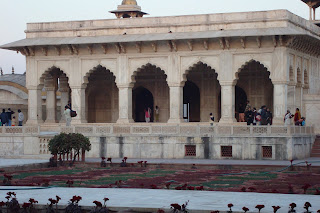
Agra Fort is a rambling conglomeration of buildings, courtyards, and gardens encircled by high sandstone walls 2.5 kilometers in circumference. Initially (as the name implies) only a fort in function, it would gradually evolve, over the course of its first 100 or so years, into a palace complex, small city, and administrative capital of the Mughal Empire, until, under British control, it was reduced to a mere fort again. Made to enclose the dreams of generations of Mughal rulers, the structure is grandiose and inscrutable. Though it doesn’t possess much or any aesthetic continuity, it is nonetheless a fantastic hashing of halls (see above) and mosques, marble and sandstone, turrets and arcades. We wandered about its grounds, stumbling dazedly in appreciation among the muddle of exquisite forms. At closing we were reluctantly shooed out of the Fort by security; as we left, the paterfamilias of an Italian clan paused before us for one last look. "Magnifico!" he exclaimed, and we snickered, but he was right—it was magnificent.

The time has now come for backtracking—not retraction precisely, just a bit of backtracking. Much has been made in this blog of the wretchedness of the tourist experience in India; it’s possible, even, that someone, perhaps rather theatrically—let us say in the spirit of showmanship—ventured to place side by side, in a rather incautious manner, two dissimilar things—for example, that peculiar, aforementioned experience and a certain nether-realm of the Christian imagination—and in so doing implied, or even suggested outright the overlapping nature of the two. And now, in the spirit of fair and evenhanded reporting, I’d like to say that the trip wasn’t all, or even mostly agitation and torment; it offered a good bit of wonder, pleasure, and appreciation, too—appreciation of the creations of both man and nature.
Tyger, Tyger: When I was seven, my best friend Michael Pecina and I whiled away many an hour imagining ourselves into tigers and the human masters at whose bidding they worked (not always to moral ends, as I recall); had I been able to undertake a trip to Rajasthan’s Ranthambore National Park then, my life may very well have turned out differently—what happens to a child who is granted the most fervent desire of his heart at such a young age? Alas, it would be twenty-one long years before I would have a chance to see a tiger in its natural setting, and even the most passionate of romantic loves rarely have sufficient reserves of ardor to burn for such a span. That’s not to say that I wasn’t pumped about the prospect of encountering the biggest of the Big Cats in the wild, only that I wouldn’t be descending into the hysterics that, had we traded places, my seven-year-old self undoubtedly would have.
Ranthambore possesses the desiccated loveliness typical of Rajasthan, with towering massifs above which, on the day of our visit, the sky crimsoned prettily in the minutes before sunrise. Due to the vagaries of booking, my sister and brother-in-law were seated in a jeep other than mine, theirs being bound for Zone 3 of the Park; my jeep, which I shared with a Mumbai investment banker and his mother, wife, and two children, sped off for Zone 5. After two hours of fruitless searching (I say fruitless though we saw two species of deer, a large antelope, crocodiles, peacocks, langur monkeys, and other sundry creatures), we turned back for the park’s entrance. “I want to see a puppy!” the little girl from Mumbai exclaimed.
Not far beyond Zone 5 we came across a cantor—a large open vehicle seating about twenty—stopped in the road, and after some feverish whispering between the guides of the two vehicles, our driver backed up a safe distance and killed the engine. Following a few breathless moments, a tiger emerged in the undergrowth of the forest perhaps fifty yards from the jeep. It strode languidly on a line parallel to the road, occasionally glancing over in our direction. We followed its path as best we could, but after less than two minutes, it was lost irrecoverably in the forest. The tiger was a three-and-half-year-old female nicknamed The Lady of the Lake; I didn’t catch her measurements or turn-offs. Alas, the zoom of my little camera proved insufficient to capture The Lady; I did, however, manage to take thirty-four seconds of video footage that make the Bigfoot tape seem, in comparison, definitive evidence of the Sasquatch’s existence.
Humayun’s Tomb: (Scene from the Bollywood film, Fanaa)
Guide: This is Humayun’s Tomb. It was constructed for him by his wife Hamida.
Husband (to his wife): Take a look at what a wife made for her husband. And you can’t even make me breakfast.
Wife: Don’t worry, I’ll start building your tomb right away.

On Christmas Day, the entire Gaff family (at right, arrayed just inside the Tomb’s walled gate), reunited for the holiday in Delhi and made its way to Humayun’s Tomb, which, though a UNESCO World Heritage Site, is little known outside of India. Humayun was the second Mughal emperor, and the elegance of his final resting place clearly influenced the design of the Mughal-built Taj Mahal. H.T. is an impressive structure to be sure, all domes and minarets and filigree, and most distinct from the Taj in its builders’ employment of red sandstone, rather than white marble, as the primary material of construction. In my most objective reckoning, ignoring the shadow cast by what was yet to come, it ranks as one of the more remarkable buildings I’ve ever seen; the Lincoln Memorial, in comparison, is a prosaic monument, pale and stunted.
The Taj Mahal and Agra Fort: In June of 2005, I made my first trip to Yankee Stadium, one of the most storied venues in all of American athletics. Site of an unprecedented number of World Series contests (and victories), the only perfect game in Series history, Reggie’s three home runs in three pitches, Maris’s 61st, and the showground for some of the game’s all-time greats, the House that Ruth Built is hollowed turf for any true baseball fan, Yankee-lover or not (I am not). It also turned out to be a huge disappointment—blandly featureless, largely devoid of charm, and—it would seem—determined to ignore its incandescent history. Forgive me for fearing that the Taj Mahal might likewise disappoint; how could it fail but to collapse beneath the weight of the stacks of purplish encomiums penned on its behalf?

And yet one glimpse was enough to dispel such fears; if nothing else, the Taj delivers on its promise of being the most visually sublime structure humankind has yet had the sensibility to erect (go ahead, try to prove me wrong). The Taj is a bit smaller than I had anticipated, but this is a cavil and in any event one quickly subsumed by the inexorable gushing of the Taj’s deathless charms: the unmatched and impeccable harmony of design; the epically suggestive (and satisfying) arches and domes; the shocking marmoreal brilliance, at once cool and white-hot; and, upon close study, the astounding flourishes of detail adorning its iconic face. It is difficult to reconcile this face of Islam, which could create something so senselessly beautiful that it approaches unearthliness, with the one which finds beauty so threatening that it must be concealed beneath chador, jilbab, and burqa.
Immediately following our visit to the Taj, we headed to the Agra Fort, our third UNESCO World Heritage Site in two days. It was certain to be a letdown—what wouldn’t be after the Taj?—but, after all, Sgt. Pepper’s had The White Album and Star Wars had The Empire Strikes Back and Joe Dimaggio had Mickey Mantle so maybe it wouldn’t be all bad. And so it proved to be; in fact, though it is no doubt blasphemy to suggest, the Agra Fort, in many ways, is the Taj’s superior. The Taj is a bit of a one-trick pony, if you’ll excuse the awful cliché; it’s absolutely stunning to look at, but in the end it’s only a tomb (how many times has someone said, “Calling X a Y is like saying the Taj Mahal is only a tomb”?). It provides little stimulation beyond that frisson of wonder one receives at first glance—although as far as frissons go, they don’t get any better.
If it were a contemporary actress, the Taj Mahal would be Penelope Cruz, who is so ridiculously, unfathomably attractive that she tends to obliterate the very consciousness of the viewer (perhaps only male viewers, and perhaps only this male viewer) to the fact that there is a story, a film, going on around her; one is also likely to fail to notice or, for that matter, even care that, after all, she can act a little too. But sit Cruz down on a talk show couch, and you quickly realize that, after a week, you’d have nothing to say to the woman. Agra Fort, then, is Cate Blanchett—beautiful too, though in an entirely differently way than Cruz, and yes, not as beautiful—but my God, she knows a bit about everything and has a crackling mind that would keep you hopping well into your dotage. Given a choice between the two for a day, or even a week, you would choose the Taj; anything longer and you would be sure to run into the arms of the Fort.

Agra Fort is a rambling conglomeration of buildings, courtyards, and gardens encircled by high sandstone walls 2.5 kilometers in circumference. Initially (as the name implies) only a fort in function, it would gradually evolve, over the course of its first 100 or so years, into a palace complex, small city, and administrative capital of the Mughal Empire, until, under British control, it was reduced to a mere fort again. Made to enclose the dreams of generations of Mughal rulers, the structure is grandiose and inscrutable. Though it doesn’t possess much or any aesthetic continuity, it is nonetheless a fantastic hashing of halls (see above) and mosques, marble and sandstone, turrets and arcades. We wandered about its grounds, stumbling dazedly in appreciation among the muddle of exquisite forms. At closing we were reluctantly shooed out of the Fort by security; as we left, the paterfamilias of an Italian clan paused before us for one last look. "Magnifico!" he exclaimed, and we snickered, but he was right—it was magnificent.
Friday, January 11, 2008
Touring as Hell, Part 3: The Dysfunction of Life and the Road Through Perdition
It was New Year’s Day, somewhere in Uttaranchal on National Highway 74--progressing between Haridwar and Ramnagar in the desultory, nauseating fashion that is the rhythm of the Indian road--when I felt something that I can only think of as vocational despair descend upon me. How, I thought, how could I look out of the car window on this day, and how could I have looked out of it the day before this, and the day before that too, and imagine a world in which poverty might one day be banished, like polio, to the loneliest margins of human experience, and what’s more believe that such a banishment might be possible in my lifetime? I couldn’t any longer, could I? Because here, here before me, was unassailable, irrefutable, inescapable evidence to the contrary, evidence that I might live one thousand lifetimes and devote each and every second of each and every one of them to improving the lives of only these very people that were this very day clustered on and along this very stretch of NH 74, and yet I would never so much as bring one kernel more of corn to the lips of a single hungry babe! The feeling, as most do, would pass within hours, but I couldn’t soon forget it.
It wasn’t any glimpse of destitution or abjection that provoked this gloominess; in fact, the countryside along the highway between cities, that is, most of what was outside of my window, approached pastoral idyll: fields of delicate yellow mustard blossoms, sugarcane, and green, seedling wheat; a colonnade of eucalyptus trees lining either side of the road; and in the distance, the foothills of the Himalayas rising above the earth like stoic deities. And the cities held no more impoverished masses than I am accustomed to encountering in Udaipur—there were no visible slums, shantytowns, or tent cities to lay low the spirit. My soul foundered on something else, something beyond a shocking image or even the accreting horror of a series of them; I was demoralized by the very process and performance of life around me, the functioning of the world that I had entered. It was dysfunction that flung my spirit to the depths, then: I had seen the dysfunction of Life, Life for the billions, and it unsettled me deeply.
I saw dysfunction in the senseless jostling of traffic, which had no one to oversee it, and in the enormous, omnipresent freight trucks built without taillights. I saw it in the man who smiled smugly as he pushed a laden handcart against traffic, and in the souls clinging to the sides and perched atop speeding buses. I saw it in the young boys awkwardly straddling motorbikes that hurtled heedlessly in the shifting interstices, and in the beggars and hawkers at car windows caught unawares by the sudden resumption of traffic, wavering in the torrent like bulrushes in a swift river. I saw a terribly dysfunctional world outside my window, and though I knew it might possibly be different because I knew a world that functioned well, despair accompanied the feeling that, after all, this particular world would never change.
Predictability is the armature upon which any economy is constructed, and conversely, unpredictability is economic poison (which is why, for example, hyperinflation (a dysfunctional currency) is the gravest ill that can befall any economy—in its throes, one can’t predict what a kilo of rice will cost in the next hour, let alone the next day). Dysfunction and unpredictability are mother and daughter: a dysfunctional world is an unpredictable one. When will the Goods Carrier arrive with produce for market? Will the investment banker make it to a vital appointment with his client? Will the city have power when that time sensitive e-mail attachment arrives? In India, it is best not to depend too deeply upon anything. Mandarins of the international economic system suggest that this country, along with China, will challenge the economic supremacy of the U.S. in the next half century; a nation with a growing middle class of a quarter billion, with an educational system that is producing millions of highly skilled workers annually, and with, by developing world standards, a stable, democratic, and upright government, possesses the necessary ingredients for sustained and prodigious economic growth, the thinking goes. This may very well be true; however, five minutes along NH 74 reveals how truly slight the possibility is that the mass of Indians will be involved in or affected by such growth.
For mired in such dysfunction, dysfunction that runs to the very core of things, how could this world change, how could the world’s billions hope to escape? When the dysfunction was so much bigger than one city, or two cities, or one thousand cities, how would they ever know respite from the onerous toil and hardship of their lives (for dysfunction makes a mockery of hard work without ever delivering one from its clutches)? I didn’t have any answers for such questions, and yet I succeeded in dispelling them with surprising speed—in my defense, I was going on safari the next day, and preoccupation was unimaginable when a tiger might dash into view and out again in a mere split second. I owed myself the forgetting, didn’t I?
Two days later, my family and I were in a car again, en route from Corbett National Park to Delhi, where I would be dropped at Nizamuddin Railway Station and they at Indira Gandhi International Airport. In late afternoon, around four o’clock, after six hours on the road, we drew near to the city—and to the conclusion of what had been, in my case, two weeks of hospital visits, car rides, harassment, and clamoring chaos without cease. There on the Hapur Bypass, between Ghaziabad and Noida, somewhere within the vast conurbation east of the city, a stunningly apt (if rather obvious) metaphor for the tourist experience appeared to me, as if by the conjuring of some supernatural power of macabre poetics. William Blake was frequently visited by ecstatic, hallucinatory vision of angels; in contrast, on January 3, I believe I saw Hell.
The suburbs outside of Delhi were engulfed in a spectral haze of dust and pollution that had settled over everything, rendering buildings in the middle distance vaporous columns of smoke and the city beyond an indeterminate jutting on the horizon. The sun was low in the sky (it sets around 5:30 this time of year) and, as if having gained in heat, glowed flash bulb white; only a faint tinge of yellow at its margins degraded the purity of its fervor. Its rays, so close to the solstice, were foreshortened and struck the earth obliquely. The haze and the sun had conspired to leech away the color of the world; all was white and that which outlined the whiteness, like a badly overexposed photograph. The people, however, were black and small and gathered thickly in places, as a dry canal bed where a cricket game raged (at this point any Indian would interject: “But it couldn’t have been hell if there was cricket!”); the strides of the bowler sent puffs of dust into the lowering haze.
From my car window, the world seemed baked by an intense and blanching heat; its dust was the steam rising from smoldering earth, its haze the sulfurous emanations of a noxious atmosphere; its inhabitants were souls charred to insignificant flecks by an implacable furnace. Then flecks, too, began to appear in the sky. First only a handful dotted its miasmic face, but then the handful of flecks became dozens, and the dozens became hundreds. The black birds wheeled in an enormous, bristling half-circle above the earth, settling over a banquet of eternal carrion. I thought I heard the chorus of their ravening cries mingling with the shrieks of the damned.
What sign was this, what omen, what augury (certainly not one of innocence, as in Blake's poem)? What, precisely, did this vision reveal? Only this: an addled and grasping mind, a strange world more sinister for its strangeness, and a city suffocating in the noisome exhalations of its machines. And one convenient metaphor.
It wasn’t any glimpse of destitution or abjection that provoked this gloominess; in fact, the countryside along the highway between cities, that is, most of what was outside of my window, approached pastoral idyll: fields of delicate yellow mustard blossoms, sugarcane, and green, seedling wheat; a colonnade of eucalyptus trees lining either side of the road; and in the distance, the foothills of the Himalayas rising above the earth like stoic deities. And the cities held no more impoverished masses than I am accustomed to encountering in Udaipur—there were no visible slums, shantytowns, or tent cities to lay low the spirit. My soul foundered on something else, something beyond a shocking image or even the accreting horror of a series of them; I was demoralized by the very process and performance of life around me, the functioning of the world that I had entered. It was dysfunction that flung my spirit to the depths, then: I had seen the dysfunction of Life, Life for the billions, and it unsettled me deeply.
I saw dysfunction in the senseless jostling of traffic, which had no one to oversee it, and in the enormous, omnipresent freight trucks built without taillights. I saw it in the man who smiled smugly as he pushed a laden handcart against traffic, and in the souls clinging to the sides and perched atop speeding buses. I saw it in the young boys awkwardly straddling motorbikes that hurtled heedlessly in the shifting interstices, and in the beggars and hawkers at car windows caught unawares by the sudden resumption of traffic, wavering in the torrent like bulrushes in a swift river. I saw a terribly dysfunctional world outside my window, and though I knew it might possibly be different because I knew a world that functioned well, despair accompanied the feeling that, after all, this particular world would never change.
Predictability is the armature upon which any economy is constructed, and conversely, unpredictability is economic poison (which is why, for example, hyperinflation (a dysfunctional currency) is the gravest ill that can befall any economy—in its throes, one can’t predict what a kilo of rice will cost in the next hour, let alone the next day). Dysfunction and unpredictability are mother and daughter: a dysfunctional world is an unpredictable one. When will the Goods Carrier arrive with produce for market? Will the investment banker make it to a vital appointment with his client? Will the city have power when that time sensitive e-mail attachment arrives? In India, it is best not to depend too deeply upon anything. Mandarins of the international economic system suggest that this country, along with China, will challenge the economic supremacy of the U.S. in the next half century; a nation with a growing middle class of a quarter billion, with an educational system that is producing millions of highly skilled workers annually, and with, by developing world standards, a stable, democratic, and upright government, possesses the necessary ingredients for sustained and prodigious economic growth, the thinking goes. This may very well be true; however, five minutes along NH 74 reveals how truly slight the possibility is that the mass of Indians will be involved in or affected by such growth.
For mired in such dysfunction, dysfunction that runs to the very core of things, how could this world change, how could the world’s billions hope to escape? When the dysfunction was so much bigger than one city, or two cities, or one thousand cities, how would they ever know respite from the onerous toil and hardship of their lives (for dysfunction makes a mockery of hard work without ever delivering one from its clutches)? I didn’t have any answers for such questions, and yet I succeeded in dispelling them with surprising speed—in my defense, I was going on safari the next day, and preoccupation was unimaginable when a tiger might dash into view and out again in a mere split second. I owed myself the forgetting, didn’t I?
Two days later, my family and I were in a car again, en route from Corbett National Park to Delhi, where I would be dropped at Nizamuddin Railway Station and they at Indira Gandhi International Airport. In late afternoon, around four o’clock, after six hours on the road, we drew near to the city—and to the conclusion of what had been, in my case, two weeks of hospital visits, car rides, harassment, and clamoring chaos without cease. There on the Hapur Bypass, between Ghaziabad and Noida, somewhere within the vast conurbation east of the city, a stunningly apt (if rather obvious) metaphor for the tourist experience appeared to me, as if by the conjuring of some supernatural power of macabre poetics. William Blake was frequently visited by ecstatic, hallucinatory vision of angels; in contrast, on January 3, I believe I saw Hell.
The suburbs outside of Delhi were engulfed in a spectral haze of dust and pollution that had settled over everything, rendering buildings in the middle distance vaporous columns of smoke and the city beyond an indeterminate jutting on the horizon. The sun was low in the sky (it sets around 5:30 this time of year) and, as if having gained in heat, glowed flash bulb white; only a faint tinge of yellow at its margins degraded the purity of its fervor. Its rays, so close to the solstice, were foreshortened and struck the earth obliquely. The haze and the sun had conspired to leech away the color of the world; all was white and that which outlined the whiteness, like a badly overexposed photograph. The people, however, were black and small and gathered thickly in places, as a dry canal bed where a cricket game raged (at this point any Indian would interject: “But it couldn’t have been hell if there was cricket!”); the strides of the bowler sent puffs of dust into the lowering haze.
From my car window, the world seemed baked by an intense and blanching heat; its dust was the steam rising from smoldering earth, its haze the sulfurous emanations of a noxious atmosphere; its inhabitants were souls charred to insignificant flecks by an implacable furnace. Then flecks, too, began to appear in the sky. First only a handful dotted its miasmic face, but then the handful of flecks became dozens, and the dozens became hundreds. The black birds wheeled in an enormous, bristling half-circle above the earth, settling over a banquet of eternal carrion. I thought I heard the chorus of their ravening cries mingling with the shrieks of the damned.
What sign was this, what omen, what augury (certainly not one of innocence, as in Blake's poem)? What, precisely, did this vision reveal? Only this: an addled and grasping mind, a strange world more sinister for its strangeness, and a city suffocating in the noisome exhalations of its machines. And one convenient metaphor.
Wednesday, January 9, 2008
Touring as Hell, Part 2: The Tourist in Transit
Early in the life of this blog, I noted the seeming frequency with which it is averred that train travel is “the best way to see the country,” an aphoristic bit of wisdom that has always carried with it the taint of the received, and which I’ve long suspected to be a pearl of sentimental rot—and of course it is, if one truly desires to absorb as much of the world about him as possible. Trains offer comparatively poor sightlines, afford no control (for passengers and engineer alike) over what route will be taken and when and where stops will be made, and, even in India, where they are generally plodding creatures, trains move too quickly to facilitate discovery and revelation. A good general rule for determining the best manner of seeing anything is based on the speed of one’s transportation: the slower the means of travel, the better for seeing. Thus, in the hierarchy of locomotion, the Concorde is worst for gaining knowledge of the world, and walking is best—how else could Gandhi legitimately claim to represent the will of the entire nation of India? He shook the dust of every highway, alley, lane, and cowpath in the country from his dhoti.
Although train journeys in India are painfully slow by American standards (for example, the Mewar Express from Delhi to Udaipur takes twelve hours to traverse its 462 mile route, provided it arrives on schedule—my most recent trip took thirteen and-a-half), they are appreciably faster than travel by car, and thus, even ignoring its other panoramic shortcomings, the train, in comparison to the automobile, is an inferior means of seeing the country. However, this is not to say that the automobile is the better way to travel in India: I feel confident in asserting that, after spending the majority of my time in transit during the past three weeks within the confines of an automobile, the car is a positively abysmal way to get from here to there. It is not merely the slowness that vexes; it is the means of delay that set the teeth on edge. Oh, you do see quite a bit in a car in India, to be sure—but much of it you wish you’d never seen at all.
How does one begin to enumerate the agonies of car travel here? Start with the roads I suppose, which, though, of generally commendable quality, are never wide enough for comfort. When one wants four lanes there are two, and when one wants two lanes there is one, and when one asks for but a single strip of asphalt, one receives rutted, dusty earth. Then move to the traffic, which is first and foremost the monstrous child of a densely populated nation and a woefully inadequate highway system, but also the outgrowth of a country which has not yet (to the incalculable benefit of the rest of the world) attained a level of affluence that permits even a fraction of its citizenry to own automobiles. Its traffic, then, is a gallimaufry of every means of terrestrial transportation conceived of since the Stone Age: horses, donkeys, camels, and elephants; horse-drawn carriages, bullock carts, handcarts, and foodcarts; bicycles, bicycle rickshaws, and auto-rickshaws both large (tempos) and small (tuk-tuks); scooters, mopeds, motorbikes, and motorcycles; cars, jeeps, vans, and light trucks; freight trucks, gas tankers, tractors, and buses; and finally, a host of other mechanical conveyances I haven’t yet names for.
I would certainly mention the complete absence of the enforcement of traffic laws, for I have never seen a motorist pulled over by the police in India, and I also I would be remiss if I failed to figure in Indians’ unique (at least as viewed through the orthodoxy of an American driver’s education course) conception of motor vehicle operation. To wit: in the Indian taxonomy of vehicular components, the horn is valued only marginally less than the engine, and the brakes are employed with only slightly less frequency and relish than the horn; training brights on other vehicles at close range, as with subjecting fellow drivers to a barrage of honking, far from being the height of insolence, is considered a communicative courtesy; every inch of road space in three dimensions is judged of inestimable value and thus contested with the pitched ferocity of a dispute over birthright; and drivers never, ever, under any circumstances, venture any distance in any direction contrary to that of their destination, even if it means traveling the wrong way down a divided street or otherwise inconveniencing every other denizen of the road.
Finally, I would lard the route with wildcards—omnigenous and unpredictable obstacles which are the last agony in this heavily abridged reckoning: speed bumps, police barriers, and miscellaneous toll and tax islands; the omnipresent domestic menagerie (dogs, pigs, goats, buffalo, chickens, and those undisputed kings of the road, cows) and their feral brethren, most notably macaque monkeys; a nation of pedestrians with more daring than brains; and the unforeseeable plaisanteries de Dieu, like the absolute halt of traffic in both directions for several minutes while a towering roadside eucalyptus is felled by handsaw.
A car ride in India, then, is a mouth full of dust and an aching head, a ready wince and a stifled gasp. It is a braced body and an unsettled stomach, widened eyes that can always grow wider and the mute communion of the transported. When it is over, one may ask, “Did you see—?” and everyone will nod before he finishes, or “Can you believe the—” and they will shake their heads before the thought is complete. It is a shibboleth, a cipher to the uninitiated, an experience that is as likely to be captured and reproduced as the first thrilling blush of love in youth—indeed, I took a minute’s worth of video with my digital camera while on the road in Agra, and afterwards we all scoffed at the pale, sanitized simulacrum offered up by its screen.
Although train journeys in India are painfully slow by American standards (for example, the Mewar Express from Delhi to Udaipur takes twelve hours to traverse its 462 mile route, provided it arrives on schedule—my most recent trip took thirteen and-a-half), they are appreciably faster than travel by car, and thus, even ignoring its other panoramic shortcomings, the train, in comparison to the automobile, is an inferior means of seeing the country. However, this is not to say that the automobile is the better way to travel in India: I feel confident in asserting that, after spending the majority of my time in transit during the past three weeks within the confines of an automobile, the car is a positively abysmal way to get from here to there. It is not merely the slowness that vexes; it is the means of delay that set the teeth on edge. Oh, you do see quite a bit in a car in India, to be sure—but much of it you wish you’d never seen at all.
How does one begin to enumerate the agonies of car travel here? Start with the roads I suppose, which, though, of generally commendable quality, are never wide enough for comfort. When one wants four lanes there are two, and when one wants two lanes there is one, and when one asks for but a single strip of asphalt, one receives rutted, dusty earth. Then move to the traffic, which is first and foremost the monstrous child of a densely populated nation and a woefully inadequate highway system, but also the outgrowth of a country which has not yet (to the incalculable benefit of the rest of the world) attained a level of affluence that permits even a fraction of its citizenry to own automobiles. Its traffic, then, is a gallimaufry of every means of terrestrial transportation conceived of since the Stone Age: horses, donkeys, camels, and elephants; horse-drawn carriages, bullock carts, handcarts, and foodcarts; bicycles, bicycle rickshaws, and auto-rickshaws both large (tempos) and small (tuk-tuks); scooters, mopeds, motorbikes, and motorcycles; cars, jeeps, vans, and light trucks; freight trucks, gas tankers, tractors, and buses; and finally, a host of other mechanical conveyances I haven’t yet names for.
I would certainly mention the complete absence of the enforcement of traffic laws, for I have never seen a motorist pulled over by the police in India, and I also I would be remiss if I failed to figure in Indians’ unique (at least as viewed through the orthodoxy of an American driver’s education course) conception of motor vehicle operation. To wit: in the Indian taxonomy of vehicular components, the horn is valued only marginally less than the engine, and the brakes are employed with only slightly less frequency and relish than the horn; training brights on other vehicles at close range, as with subjecting fellow drivers to a barrage of honking, far from being the height of insolence, is considered a communicative courtesy; every inch of road space in three dimensions is judged of inestimable value and thus contested with the pitched ferocity of a dispute over birthright; and drivers never, ever, under any circumstances, venture any distance in any direction contrary to that of their destination, even if it means traveling the wrong way down a divided street or otherwise inconveniencing every other denizen of the road.
Finally, I would lard the route with wildcards—omnigenous and unpredictable obstacles which are the last agony in this heavily abridged reckoning: speed bumps, police barriers, and miscellaneous toll and tax islands; the omnipresent domestic menagerie (dogs, pigs, goats, buffalo, chickens, and those undisputed kings of the road, cows) and their feral brethren, most notably macaque monkeys; a nation of pedestrians with more daring than brains; and the unforeseeable plaisanteries de Dieu, like the absolute halt of traffic in both directions for several minutes while a towering roadside eucalyptus is felled by handsaw.
A car ride in India, then, is a mouth full of dust and an aching head, a ready wince and a stifled gasp. It is a braced body and an unsettled stomach, widened eyes that can always grow wider and the mute communion of the transported. When it is over, one may ask, “Did you see—?” and everyone will nod before he finishes, or “Can you believe the—” and they will shake their heads before the thought is complete. It is a shibboleth, a cipher to the uninitiated, an experience that is as likely to be captured and reproduced as the first thrilling blush of love in youth—indeed, I took a minute’s worth of video with my digital camera while on the road in Agra, and afterwards we all scoffed at the pale, sanitized simulacrum offered up by its screen.
Monday, January 7, 2008
Touring as Hell, Part I: The Tourist at Home
I have seen India with fresh eyes. Udaipur, my tranquil home away from home, the placid city of placid lakes, a place whose hazy hills inspire soft reverie and gentle existence, is no more representative of the country than Bucharest. Though Udaipur may claim its share of chaos—that born of traffic and unrestrained commerce and a crush of humanity—it is a chaos within bounds. India, taken as a whole, is chaos without bounds—without check, bridle, or regulation.
To be fair, Old City, the feverish omphalos of Udaipur’s tourist trade (and therefore, in many ways, the palpitating heart of its economy) does conjure the rest of the country in all of its bumptious and disorienting intensity. It is a dense cluster of shops, cafés, and small hotels carved from havelis—majestic mansions of a bygone era—arrayed along the narrowest of possible streets, which have been thrust down in a tangle on the shores of Lake Pichola. It is populated by a teeming, grubbing, hectoring mass of hawkers, touts, beggars, legitimate businessmen, and holy fools (or foolish holy men, rather) who afford visitors not a moment of peace. Forget my first impressions recorded in this very blog—the “evident” charms of Old City are vitiated after even a few moments of lingering within its confines.
On their first night in Udaipur, my sister and brother-in-law and I hazarded an early evening stroll along Old City’s choked and claustrophobic roadways; after perhaps fifteen minutes, weary of dodging traffic, weary of the come-ons from avaricious shopkeepers, weary of the cacophony of motor vehicle horns echoing from the close walls, our noses and eyes piqued by the creeping fingers of incense smoke, we turned back for their hotel room. Little then did I know—though I would learn it too well over the succeeding two-and-a-half weeks—that the misery of our ill-advised jaunt through Old City was, in fact, a pure expression of the tourist experience in India. Eschewing euphemism, life as a tourist in those places of this country created or adapted to “serve” visitors with money is one very convincing version of the Christian hell—that is, provocation, agitation, and torment without cease. (And I believe I truly glimpsed Hades risen to earth while threading the road between Noida and Ghaziabad outside of Delhi last Thursday—but more on that later.)
Thankfully, an Udaipur exists beyond the bounds of Old City’s walls; the city is far more than the life-sucking maelstrom churning and blowing like the breath of some infernal bellows through Old City’s oppressively narrow streets, though most tourists wouldn’t know it. When I arrived in Udaipur, I asked Arun, my roommate, whether he liked the city. “Yes, it is nice place,” he responded (with the characteristic Indian omission of an article), and at the time I didn’t know whether he said this merely out of politeness or whether he had meant it—in any event, it seemed a lukewarm endorsement. But having since come to know Arun better, and having recently come to know some of India outside of Udaipur, I now realize that he spoke with sincerity: through Indian eyes at the very least, Udaipur is a pleasant place.
And on the morning following our walk, my sister and brother-in-law took an auto-rickshaw north through Udaipur to Seva Mandir’s offices and pronounced the city lovely and charming; later in their visit, after traversing a gauntlet of other tourist spots, they would declare it their favorite stop in the trip—and that in spite of the fact that my brother-in-law spent three nights in the hospital here recovering from a nasty case of gastroenteritis (Delhi Belly) brought on by contaminated food or water.
Perhaps, then, if Udaipur cannot be judged by the face it chooses to reveal to tourists, the rest of India is capable of redemption as well—perhaps. I cannot judge with any particular confidence; after all, I’ve only seen a comparatively small swath of the country, and every inch of it was cheaply adorned and then exposed for the distraction and delectation of its moneyed visitors, like the made up Mardi Gras reveler lifting her top with one hand while extending the other in anticipation of beads. I am not, then, inclined to be entirely charitable in my estimation of that which I’ve seen.
To be fair, Old City, the feverish omphalos of Udaipur’s tourist trade (and therefore, in many ways, the palpitating heart of its economy) does conjure the rest of the country in all of its bumptious and disorienting intensity. It is a dense cluster of shops, cafés, and small hotels carved from havelis—majestic mansions of a bygone era—arrayed along the narrowest of possible streets, which have been thrust down in a tangle on the shores of Lake Pichola. It is populated by a teeming, grubbing, hectoring mass of hawkers, touts, beggars, legitimate businessmen, and holy fools (or foolish holy men, rather) who afford visitors not a moment of peace. Forget my first impressions recorded in this very blog—the “evident” charms of Old City are vitiated after even a few moments of lingering within its confines.
On their first night in Udaipur, my sister and brother-in-law and I hazarded an early evening stroll along Old City’s choked and claustrophobic roadways; after perhaps fifteen minutes, weary of dodging traffic, weary of the come-ons from avaricious shopkeepers, weary of the cacophony of motor vehicle horns echoing from the close walls, our noses and eyes piqued by the creeping fingers of incense smoke, we turned back for their hotel room. Little then did I know—though I would learn it too well over the succeeding two-and-a-half weeks—that the misery of our ill-advised jaunt through Old City was, in fact, a pure expression of the tourist experience in India. Eschewing euphemism, life as a tourist in those places of this country created or adapted to “serve” visitors with money is one very convincing version of the Christian hell—that is, provocation, agitation, and torment without cease. (And I believe I truly glimpsed Hades risen to earth while threading the road between Noida and Ghaziabad outside of Delhi last Thursday—but more on that later.)
Thankfully, an Udaipur exists beyond the bounds of Old City’s walls; the city is far more than the life-sucking maelstrom churning and blowing like the breath of some infernal bellows through Old City’s oppressively narrow streets, though most tourists wouldn’t know it. When I arrived in Udaipur, I asked Arun, my roommate, whether he liked the city. “Yes, it is nice place,” he responded (with the characteristic Indian omission of an article), and at the time I didn’t know whether he said this merely out of politeness or whether he had meant it—in any event, it seemed a lukewarm endorsement. But having since come to know Arun better, and having recently come to know some of India outside of Udaipur, I now realize that he spoke with sincerity: through Indian eyes at the very least, Udaipur is a pleasant place.
And on the morning following our walk, my sister and brother-in-law took an auto-rickshaw north through Udaipur to Seva Mandir’s offices and pronounced the city lovely and charming; later in their visit, after traversing a gauntlet of other tourist spots, they would declare it their favorite stop in the trip—and that in spite of the fact that my brother-in-law spent three nights in the hospital here recovering from a nasty case of gastroenteritis (Delhi Belly) brought on by contaminated food or water.
Perhaps, then, if Udaipur cannot be judged by the face it chooses to reveal to tourists, the rest of India is capable of redemption as well—perhaps. I cannot judge with any particular confidence; after all, I’ve only seen a comparatively small swath of the country, and every inch of it was cheaply adorned and then exposed for the distraction and delectation of its moneyed visitors, like the made up Mardi Gras reveler lifting her top with one hand while extending the other in anticipation of beads. I am not, then, inclined to be entirely charitable in my estimation of that which I’ve seen.
Subscribe to:
Posts (Atom)